 Donate
 Basket
 Login
Login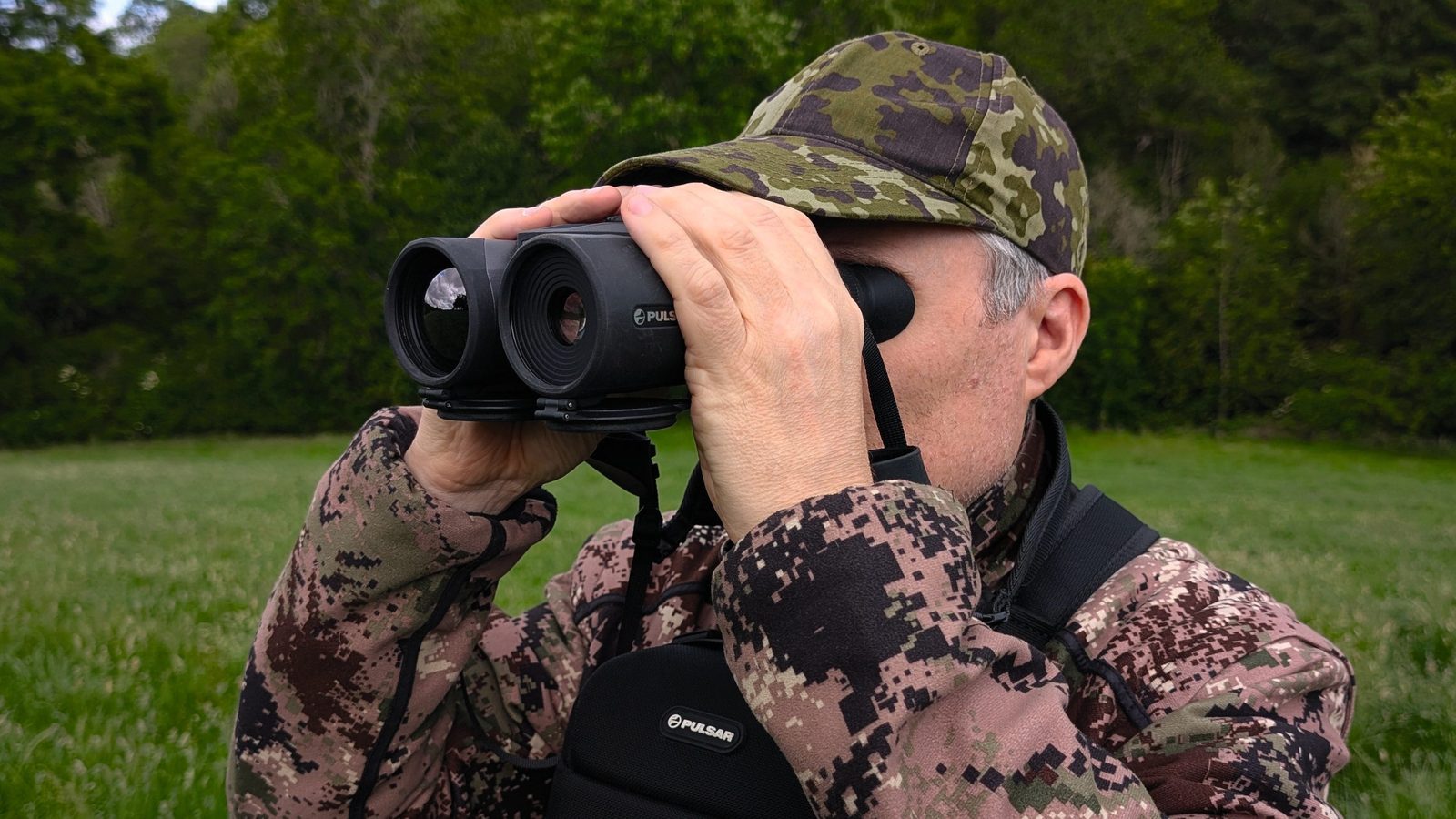
The Pulsar Symbion LRF DXR50 has the kind of review a counter can demonstrate against: a tester who prefers the thermal channel, admits the digital side is nothing special, and still calls the £3,779.95 binoculars “simply the best to buy”. Writing in Sporting Gun, Jules Whicker tested the multispectral binoculars by day and night on deer and reported “the best user experience I’ve ever had with multispectral binoculars by a country mile”. For UK dealers, distributed by Thomas Jacks, that is the sale in one sentence, and the review names the reason the ticket holds.
“Pulsar knows that it can’t beat the big Chinese electro-optical conglomerates on price,” Whicker wrote, so it competes on quality and user experience. The trade conversation about the premium multispectral category is exactly that: what the dearer European unit gives the customer that the cheaper rivals do not, and the review answers it in the hand rather than on the spec sheet.
What the Symbion LRF DXR50 is, and what it replaces
The Symbion carries a 50mm thermal imager in one barrel and a 4K digital day and night camera in the other, with an 850nm LED illuminator (flood-to-spot), a laser rangefinder to 1,500m and a 1920×1080 AMOLED display. It weighs 1kg, ships with two APS5 batteries and a twin charging dock, charges over USB-C and has a recommended retail price of £3,779.95; the review gives pulsar-vision.co.uk as the contact.
The category argument for the customer is consolidation. A multispectral binocular replaces a thermal monocular, a daylight binocular and a separate rangefinder with one device and one battery system, and lets the user confirm identity without changing hands. That is also the argument against a lower ticket, because the customer is comparing it with three purchases, not one.
Where the review says the money goes
Not into the digital channels. Whicker rated the thermal brilliant, the day digital good and the night digital “short on range” because the on-board illuminator lacks reach; by day he kept Leica binoculars in his back pocket for “pin-sharp detail, true colour and zero latency”, and at night he used thermal almost exclusively. His conclusion on the trade-off is the line a dealer can repeat: “In truth, I don’t care about these limitations because, as with all multispectral binoculars, the digital channel simply makes the thermal channel more meaningful.”
The money goes into the thermal and the handling. On thermal: “It does thermal notably better than the Chinese units I’ve tried – the image feels more realistic and less AI-enhanced – but delivers nothing special in digital terms.” On handling: a tandem focus dial with the thermal on the small wheel and the digital on the large, a three-position power switch that works like a rifle safety, two groups of rubberised buttons that can be assigned to either hand, and armour that “feels tougher, grippier and better integrated than anything I’ve previously tested”. The digital interface, the Stream Vision apps and the Stream Vision Ballistics holdover function completed the case. His single criticism was the black finish where green, bronze or flat dark earth would suit a device used by day as much as at night.
Why the counter demonstration decides this sale
Every line of the review that justifies the price is tactile: the focus dial, the switch, the buttons under the fingertips, the armour. None of it shows on a website listing, which makes the Symbion a demonstration product rather than a catalogue one, and the customer who has handled it beside a cheaper unit is the customer who understands the gap. The supplied kit matters on the counter too: a neoprene strap with quick-detach clips, a padded case with a silent roll-forward top, and two harness options, one converting to a bino caddy, which Whicker described as first-class in materials and stitching.
The rangefinder is the other demonstrable. Ranging a roebuck at 726m, less than half the 1,500m reach, was “a breeze”, and once a rifle’s ballistic profile is uploaded through the app the unit returns a holdover with each range. For a deer-management customer that is the feature that moves the Symbion from an observation tool to a shooting one.
What happens next
The Symbion LRF DXR50 is listed at pulsar-vision.co.uk, the review’s contact, and reaches UK counters through Thomas Jacks. The full test, with Whicker’s notes on the apps, the carrying solutions and the verdict, is on Sporting Gun. Dealers stocking the unit should plan the demonstration around the controls and the thermal image, which is where the review says the ticket is earned.
Useful links
Sporting Gun – Pulsar Symbion LRF DXR50 review: multispectral binoculars tested, Jules Whicker’s original test
Pulsar – the brand’s UK site, the contact the review gives for the Symbion range
Thomas Jacks – Pulsar’s UK distributor
Frequently asked questions
What is the recommended retail price of the Pulsar Symbion LRF DXR50?
£3,779.95 at the time of Sporting Gun’s review, published on 3 October 2026, with Thomas Jacks as Pulsar’s UK distributor.
What did the review say the Symbion does better than cheaper rivals?
Thermal imaging, with an image the reviewer found more realistic and less AI-enhanced than the Chinese units he had tried, and the handling: the focus dial, the power switch, the button layout and the armour.
Where is the Symbion weakest?
The night digital channel, which the reviewer found short on range because the built-in infrared illuminator lacks reach; an external illuminator can be fitted via the tripod socket.
Related articles
Leupold’s latest optics arrive in the UK, exclusive to Viking Arms – how a premium optics brand reaches UK retailers
ATN Mars LTV 256 Series – the entry point to thermal riflescopes on the counter
Feeling the heat on a thermal rat roundup – a thermal monocular put to work