 Donate
 Basket
 Login
Login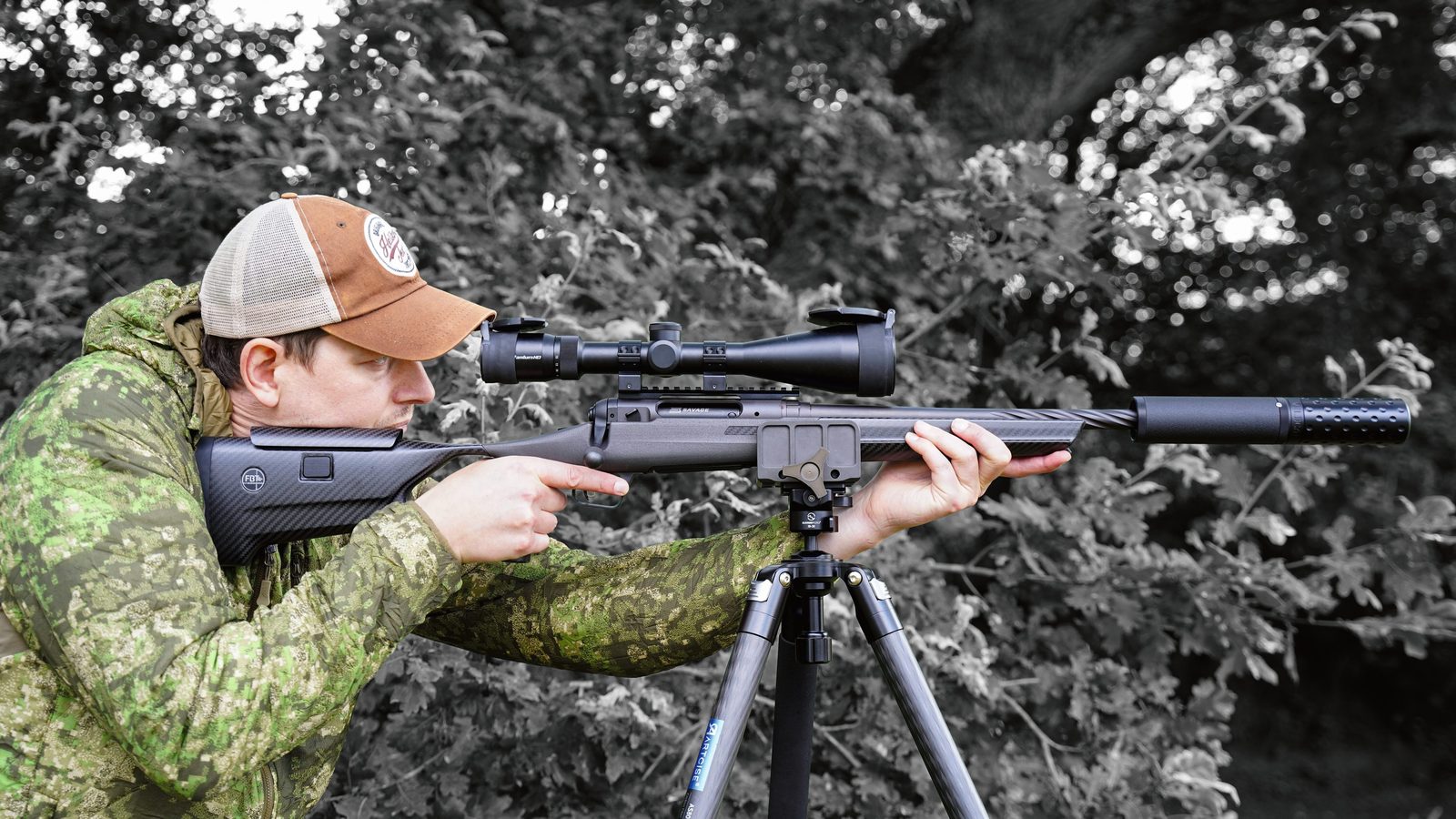
Viking Arms distributes Savage rifles in the UK, and I thought it a good idea to focus on a different stablemate: the 110 FBT Hunter. At a suggested retail price of £2,210, it is still a significant investment, but it brings Savage’s lightweight ambitions within much closer reach.
The Savage 110 platform has spent decades building a reputation for out-of-the-box accuracy and reliability. So, if you are in the market for a lightweight hunting rifle and fancy something a little different, let’s get stuck in.
Savage 110 FBT Hunter specification
| Feature | Savage 110 FBT Hunter |
|---|---|
| Calibre | .308 Win (on test) |
| Barrel | 18in steel, spiral fluted, free-floated, 19mm muzzle, 5/8×24 thread (on test) |
| Overall length | 39in |
| Weight | 6.6lb (2.9kg) |
| Length of pull | 14.5in |
| Magazine capacity | 4+1, flush-fitting detachable box |
| Trigger | Savage AccuTrigger, user adjustable (3lb 2oz on test) |
| Stock | Carbon-fibre FBT (Fine Ballistic Tools) thumbhole, adjustable cheekpiece |
| Price | £2,210 |
| UK distributor | Viking Arms |
How much does the steel barrel add to the weight?
The Klym’s headline feature was its featherweight build, tipping the scales at just 6.2lb (2.8kg). This was primarily down to two premium components: a Proof Research carbon-fibre-wrapped barrel and a carbon-fibre stock.
As the name suggests, the 110 FBT retains that high-end stock but swaps the carbon barrel for a conventional factory steel alternative. It is this sensible substitution that accounts for the welcome drop in price, making the rifle more accessible.
So, how much does the rifle’s weight increase with the steel barrel? Not much, actually. This rifle weighs 6.6lb (2.9kg), around 0.4lb more than the Klym. This has been achieved by reducing the barrel length from 22in to 18in and including spiral fluting to shave off a few more grams.
Naturally, a shorter barrel means a slight drop in muzzle velocity, but the review rifle was chambered in .308 Win, a calibre that is perfectly happy in a shorter tube. The Savage barrel is fully free-floated back to the reinforce and has a heavy sporter/semi-weight profile, with a 19mm muzzle diameter. It comes with a thread protector on a 5/8×24 thread, leaving the owner well placed to fit a suitable sound moderator.

The reduced barrel length makes the rifle light, manoeuvrable and enjoyable to handle. Even when fitted with a scope, it avoids feeling top-heavy. However, it did become front-heavy once a sound moderator was fitted, highlighting just how light the stock is.
Action and floating bolt head
At the heart of the system is Savage’s signature floating bolt head. Rather than using a rigid, one-piece bolt design, the setup allows a small degree of self-aligning movement, ensuring both locking lugs square up for consistent lock-up.
The bolt uses a traditional 90-degree lift. Cycling is smooth, although closure is quite firm and induces a subtle twist of the rifle in the hands, meaning it does not feel quite as slick as some rivals at this price point. The rear shroud features a clear, tactile cocked-action indicator.
On the bolt face, the push-feed system uses twin plunger ejectors and a recessed extractor claw to throw spent cases clear with authority. The smooth bolt body features Savage branding when closed and is paired with a 55mm bolt handle with a rounded, lightly knurled 19mm knob.
In use, the handle runs quite close to the scope eyepiece, but it is long enough to provide a decent hold for efficient operation.
The receiver uses Savage’s long-established 110 action, constructed from carbon steel and featuring a gas-escape vent on either side. The metalwork has a hard-wearing matte-black finish. Rather than the skeletonised relief cuts found on some more expensive Savage models, the receiver retains a solid-walled profile.
A robust, one-piece Picatinny rail is fitted as standard. The ejection port is 80mm long and 16mm wide, making it easy enough to drop a loose round into the chamber for a quick follow-up shot.
Magazine, safety and AccuTrigger
Rather than a traditional hinged floorplate, Savage has equipped the rifle with a flush-fitting detachable box magazine, a feature likely to appeal to many shooters.
The hybrid polymer-and-metal magazine holds 4+1 rounds of .308 Win and is retained by an integral sprung button at the front. The release mechanism is somewhat exposed, however, leaving it potentially vulnerable to being tripped by branches or heavy foliage.
Instead of a receiver-mounted rocker safety, there is a bolt-release catch, while a three-position tang safety is operated easily with the thumb. Forward is ‘fire’, the middle position blocks the trigger and the rear position locks everything. However, it is easy to overrun the middle position.
Naturally, the rifle features Savage’s AccuTrigger, identified by the silver inner safety blade that gives it a pseudo-two-stage feel. The trigger is fully user-adjustable and, on the review rifle, the single-stage break was consistent and clean at 3lb 2oz.
I got on with it surprisingly well and became rather fond of it. Great job, Savage.
The carbon-fibre FBT stock
A significant proportion of the rifle’s cost can be attributed to the carbon-fibre FBT (Fine Ballistic Tools) stock. It has a generous thumbhole configuration and three-piece construction, comprising a carbon fore-end and butt section with a polymer centre.
At the rear is a 0.75in rubber recoil pad, providing a 14.5in length of pull. This is paired with a push-button adjustable cheekpiece, offering more than 1in of travel for correct scope alignment.
I did find a touch of play in the cheekpiece, but it is clear that FBT is walking the tightrope between ultimate light weight and rigidity.
The butt has a sling stud, bag-rider cut-out and a smooth vertical pistol grip with twin palm swells. These promote consistent hand and trigger-finger placement from a range of shooting positions.
The central polymer section has a textured surface and houses the polymer bottom metal, including a generous trigger guard and the magazine well. The carbon-fibre fore-end measures 16in from the trigger guard to its tip. The flush-fit magazine means all of this space can be used on shooting sticks.
While the angled sling stud at the fore-end tip cannot be used as a conventional bipod mount, the rifle has an integrated Magnaswitch system to accept a Spartan bipod or similar. On inspection, there was enough flex in the fore-end to cause intermittent contact with the free-floated barrel, although this did not cause any point-of-impact shift during testing.
A well-defined finger groove runs along each side, providing a decent leading-hand hold.

How accurate is the Savage 110 FBT Hunter?
As this rifle is firmly aimed at the hunting market, I tested it with appropriate accessories: a Delta Titanium 2.5-15×56 riflescope and a Wildcat Evo sound moderator. Without a compatible bipod, I used a padded support.
My usual caveat when testing a lightweight rifle is that it can be difficult to shoot as well as a heavier counterpart. Less mass generally means greater felt recoil, exposing the shooter’s flaws. That’s me.
My aim was not to chase benchrest precision with match-grade ammunition, but to see whether the rifle could deliver sub-MOA performance with standard hunting ammunition. Happily, felt recoil was remarkably manageable, allowing me to get on with thorough testing without getting beaten up.
Accuracy with 150-grain Winchester Ballistic Silvertip ammunition was excellent. I fired three, three-shot groups, with an average group size of 0.609in at 100 yards. The ammunition recorded 2,760fps, an extreme spread of 24fps and 2,538ft/lb of energy.
The rifle did not like Hornady’s Precision Hunter 178-grain ELD-X, however, with each group measuring more than 2in. The figures were 2,493fps, an extreme spread of 17fps and 2,457ft/lb.
Keen to see how the Savage coped with non-lead ammunition, I tried 150-grain Hornady ECX. Again, the rifle performed very well, with an average group size of 0.660in. These rounds produced 2,770fps, an extreme spread of 11fps and 2,556ft/lb.
Strengths and weaknesses
Strengths
- Only 0.4lb heavier than the carbon-barrelled Klym, at a lower price
- Short, light and manoeuvrable, and not top-heavy with a scope
- Sub-MOA groups with both lead and non-lead hunting ammunition
- Felt recoil remarkably manageable for a light rifle
- Clean, consistent AccuTrigger
- Flush-fitting detachable magazine and threaded barrel
Weaknesses
- Firm bolt closure twists the rifle slightly in the hands
- Exposed magazine release could be tripped by foliage
- Easy to overrun the middle safety position
- A touch of play in the cheekpiece, and fore-end flex that made intermittent contact with the barrel
- Front-heavy with a moderator fitted
Verdict
I will admit that, on first handling, the Savage 110 FBT Hunter does not feel quite as slick as several rivals at this price point. The firm bolt closure also induces a subtle twist in the hands during operation.
However, once on the range, the rifle proved a really good surprise. Its downrange performance delivered the confidence every stalker wants, printing sub-MOA groups with both traditional lead and modern non-lead ammunition.
The standout was that, for such a lightweight set-up, felt recoil was remarkably manageable. Paired with the crisp, intuitive AccuTrigger, it is a genuinely engaging rifle to shoot.
By opting for a short, fluted steel barrel rather than a carbon-wrapped tube, Savage has created a lightweight, highly manoeuvrable package that will appeal to carbon sceptics while bringing the price down. Any minor operational quirks are quickly forgiven when you see the group sizes.
Many thanks to Rose Hill Farm Rifle Range, Suffolk, for the use of its facilities for this review.
Frequently asked questions
How much is the Savage 110 FBT Hunter?
The suggested retail price is £2,210. It is distributed in the UK by Viking Arms.
How does the 110 FBT Hunter differ from the Savage Klym?
It keeps the Klym’s carbon-fibre FBT stock but replaces the Proof Research carbon-wrapped barrel with a shorter 18in spiral-fluted steel barrel. That brings the price down and adds only about 0.4lb, for a weight of 6.6lb (2.9kg).
Will the Savage 110 FBT Hunter shoot non-lead ammunition?
Yes. On test in .308 Win, 150-grain Hornady ECX averaged 0.660in groups at 100 yards, close to the 0.609in achieved with 150-grain Winchester Ballistic Silvertip.
Is the 110 FBT Hunter barrel threaded?
Yes. The free-floated barrel comes with a thread protector on a 5/8×24 thread, ready for a sound moderator.