 Donate
 Basket
 Login
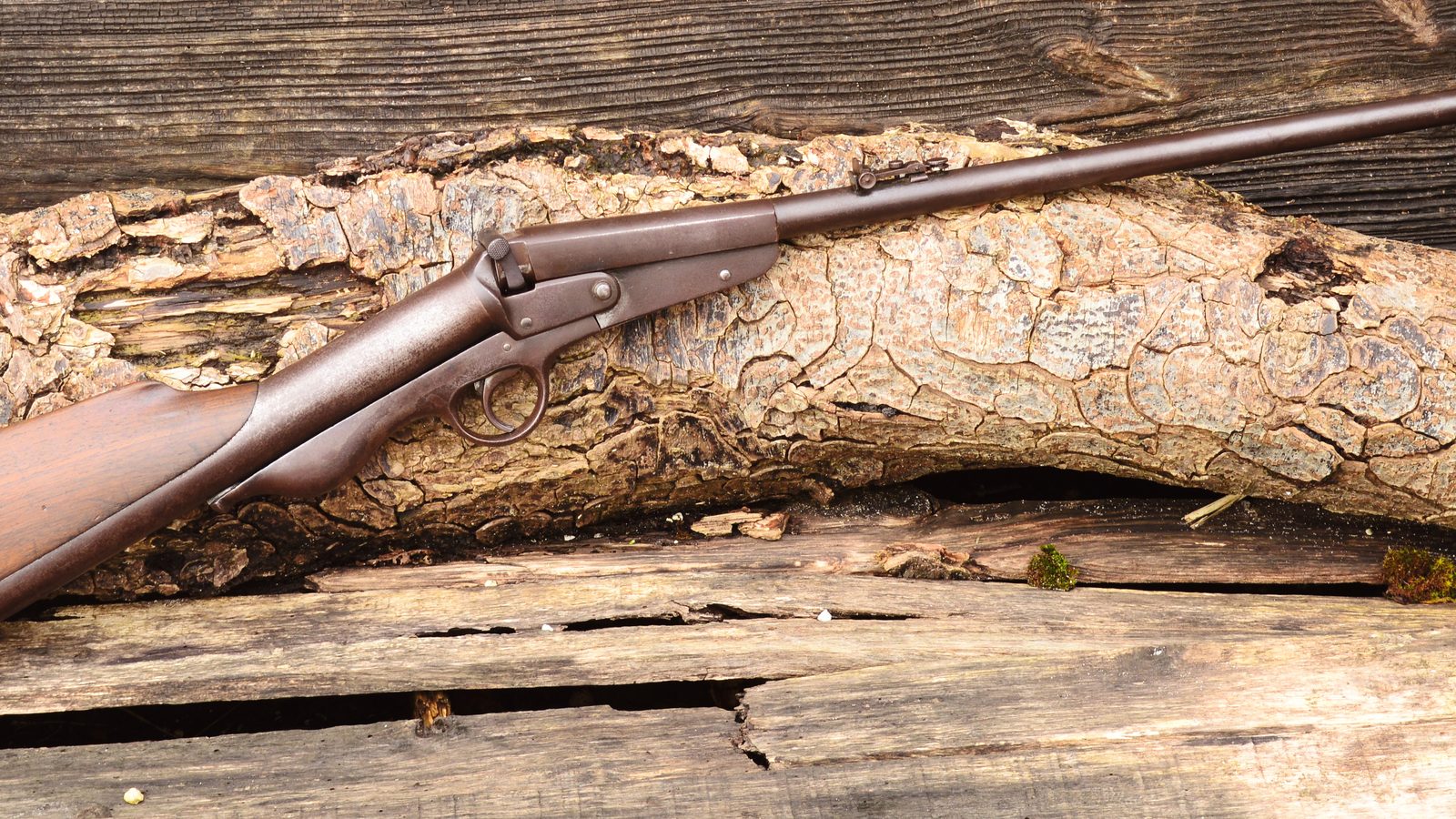
The Britannia air rifle, an Edwardian break-barrel designed by a man named Cox and finished in Birmingham by Bonehill, has had a full appraisal in Airgun World, and it gives the pre-owned counter a reference for a rifle that arrives perhaps once in a career. Writing in Airgun World, Jon Young put the find rate at “20-odd Lincoln Jeffries or later BSA Improved Model Ds to only one or two Britannias”.
Why does the Britannia command attention in the pre-owned trade?
Scarcity is the first reason. Young wrote that “very few Britannias were ever made, most probably only in the low thousands”, that the number has “diminished dramatically” and that prices “have unfortunately risen exponentially”. The second reason is engineering. The Britannia answered the Gem’s weakness, a leather breech seal that wore and let the barrel loosen, with a sprung catch over a tapered breech that, in Young’s words, “compensates for this by being pushed further back onto the taper by its own spring”.
The marks and features that confirm a Britannia
The metal carries the two names a counter needs, Cox’s Patent for the designer and Bonehill for the maker. Young noted that some early examples appear to have been made in Germany as parts and castings for Cox to assemble, before the Birmingham firm took the project on and had the rifles hand-finished “by those more accustomed to gunsmithing than rough foundry work”.
The layout is a long spring chamber running back to the shoulder, cocking by the trigger guard, a rifled barrel, threaded screws in place of the Gem’s tapered pins and an adjustable trigger. Finishes include two-tone plating, blacked barrels with nickel spring chambers, in the German fashion of the period. An earlier, simpler version exists without the catch at the top, and variations in cocking lever, barrel length and sights, from static to folding leaf to the see-saw backsight, all bear on a valuation. Young warned that the see-saw sight’s “tiny parts often go missing”.
Which calibre claims should the counter test?
Almost all Britannias are .177, with a far smaller number, mostly from later production, in No 3 Bore, the .25in calibre. The one to question is .22. Young wrote that despite examples surfacing over the years, “it appears that this calibre was never considered for the Britannia at least during factory manufacture”, so a .22 example needs a closer look before it is described as factory-made.
Retailer-branded Britannias are not unusual for the period, and an unknown number were built under contract for a firm called R Ramsbottom and marked as the Anglo Sure Shot Mark I. A counter that knows the name will not pass one by.
Condition against function: the valuation question
Young’s view challenges the trade’s usual order of priorities. Condition, he wrote, is what a dealer cites when selling expensive stock or buying cheaply, yet with a Britannia few, if any, survive in their best original finish. Period workshop refinishing and plating have left many “rather dull and grey”, and most have been historically refinished, so he argued that “due to rarity, original condition can take second place in the world of rare airguns”.
His conclusion is that “the better gun, however, one that works well enough to use today, may be the rougher example of the two”. That is a point the counter can use both ways: a sound mechanism supports a price on a plain rifle, and a refinished example is the norm for this model rather than the exception, unlike a factory-finished BSA of the same period.
What happens next?
A Britannia’s mechanism can be inspected on the spot. A short piston and spring sit over an extra-long spring guide with no real pre-load, and, as Young put it, “only a coin was needed to undo the rear chamber end plug”; a quarter turn frees the mainspring and piston in seconds to check the piston seal. Jon Young’s full feature, with the pictures of the catch, the markings and the sight, is in Airgun World, linked first below.
Useful links
The Britannia air rifle: the Edwardian break-barrel that bettered the Gem – Jon Young’s original feature in Airgun World, where these words first appeared, with the pictures of the catch and the markings
Frequently asked questions
How do you identify a Britannia air rifle?
By the Cox’s Patent and Bonehill markings, the sprung catch over a tapered breech, trigger-guard cocking and a long spring chamber running back to the shoulder. A retailer-branded Anglo Sure Shot Mark I is also a Britannia.
Was the Britannia air rifle made in .22?
Jon Young wrote that it appears not to have been, at least during factory manufacture. Almost all are .177 and a smaller number are No 3 Bore, the .25in calibre, so a .22 example needs checking.
How rare is the Britannia air rifle?
Very few were made, most probably only in the low thousands, and far fewer survive. For every one or two Britannias, Young wrote, you may see 20-odd Lincoln Jeffries or later BSA Improved Model Ds.
Related articles
Refurbishing: Is it dead? – the trade’s view of restored and refinished stock
Weihrauch HW30S review gives UK dealers a fresh case for the starter springer this autumn – the trade reading of another Airgun World verdict
SGC Group’s formula for success – how a UK airgun distributor reads the 2026 market