In Conversation with Simon West OBE, Executive Director GTA

Back to blog

The GTA’s Role in Addressing Key Challenges Faced by the Gun Trade

Far less frequently now, I get asked “What does the GTA do for me?” but I always welcome the challenge to ensure we keep your trade’s association on track.

This year we have been dealing with a growing number of challenges but, at the same time, I feel we are getting ever more traction with the decision-makers we need to reach.

I’m sorry to start with lead – but this is vital to all of us.

Through a desire to stay matched with Europe on chemical restrictions – and probably with a hint of political ambition – the Government made its proposals on moving away from lead in ammunition in outdoor use through the HSE restriction process.   The HSE largely copied what had been produced in Europe by their chemicals agency – ECHA.

When we were asked to contribute evidence to the consultation last year, I provided detailed information on a wide range of topics.  That seemed to fall on deaf ears and the proposals that were published back in May showed little sign they were listening.  We have now had the second phase of consultation where we submitted further detailed evidence on what the industry could realistically achieve and where there were technical issues in their proposals.  I do not have huge confidence in the process but I have recently picked up that they realise there is a need to talk to industry.  I hope so.  I will certainly be keeping the pressure on.

On delays in licensing.  We have been reporting to the Home Office for some time that there are unacceptable delays in some areas.  The message I got back six months ago was that it was a force-level issue – and not their problem.  Following my Freedom of Information request to the National Police Chiefs’ Council lead for firearms licensing in August (which she was unable to answer at the time), I have now discovered that both the NPCC lead and the Home Office are taking an interest and have compiled the data.  In a parliamentary committee recently, the Policing Minister actually reported there were 7 forces over which he had concerns.  Finally, through GTA pressure, there is somebody taking an interest at the national level and helping to rectify the situation.   There is now sharing of best practices, a reallocation of resources and an urgency to get licensing back on track.

Where I have seen particular issues, I have sought to engage at the local level.  In Devon and Cornwall, through direct engagement, we have made the staff aware of the challenges to small businesses through delays and their inappropriate use of temporary Section 7 permits.  I think this message hit home and I’m delighted that they agreed to work with the trade, reduce the use of permits and process a block of long-awaited variations.  And the meetings continue.

Other things I am working on at the strategic level include the review of firearms licence fees, removal of moderators from licensing control, the trade’s interest in the future of the police licensing computer management system, criminal use of firearms, import and export licensing, airgun safety, licensing officer training and approved professional practice, medical checks, paper applications – to name a few.  All of these help maintain your ability to operate and do business.

Beyond that, we seek to be proactive in support of trade needs.   We continue to deliver very well-received RFD training courses, with Paul Green, our new technical advisor at the helm.  In 2023 we will also be offering Airgun-only one-day RFD training courses.  Paul and I are also in the process of writing a new ‘RFD Handbook’– a quick reference guide for all your desks.

As a trade, we are desperately in need of more trained gun fitters, gunsmiths and gun-making craftsmen.  We will be returning to our ‘careers in the gun trade’ recruiting efforts in 2023.  I am in discussions with training providers to link us to existing manufacturing and machining apprenticeship programmes to build our capacity.  If you would like to take on an apprentice in your workshops, please let us know.  Once we have a working link with a course provider, I hope we can spread the model nationwide.

We will also be running the Trade Conference again next year.  Following on from this year’s popular event, we will pick topical issues and provide a forum to exchange information and viewpoints that can benefit all of us.

That list of current activities may not address all your issues.  We are here to assist with whatever interesting challenges you might be facing.  Between me, Lin and Paul, I think we have the skill set and determination to deal with most things.  We will be at shows, game fairs and other shooting events and we are always available by phone or email; please keep the communication coming.

We cannot operate without you as members.  Thank you for your support and for empowering us to maintain the Trade’s operating environment and business opportunities.

Other News Posts

On the Road Again by Stuart Farr, Firearms solicitor

Back to blog

The Life of a Gun Trade Salesperson

I can well imagine that life on the road for any gun trade salesperson will have its “ups” and “downs”.

On the “up” side, there is always the opportunity to meet interesting and like-minded people in the trade. Indeed, after practically two years of only virtual contact via phone or computer, it must feel good to get out again and be able to shake hands and enjoy a brew with people. And let’s face it, life during those lockdown days was pretty tough. Sales targets were practically thrown out of the window, while the doors of bricks and mortar retailers were forced shut with businesses grinding to a trickle.

The “down” side, on the other hand, paints an image of a potentially lonely existence for anyone needing to travel the length and breadth of the country between appointments. With companionship supplied by the Sat Nav (“perform a U-turn where possible”), the mobile phone (“when will you be home?”), and what’s left of the (better) BBC Radio 2 DJs, it is easy to contemplate the temporary excitement that a brief stop-off at Tebay services (as seen on TV) may provide.

Then, of course, there is the security issue. Gun traders cannot simply meander about in a carefree manner. Their cargo requires care and responsibility. It is not the sort of stuff which can be allowed to fall into the wrong hands. Hence, a degree of advanced planning is needed.

The existing guidance in relation to firearms licensing, confirms that anyone transporting firearms or ammunition as part of the ordinary business of an authorised registered firearms dealer should always carry a copy of a letter of authority, together with a copy of the dealer’s certificate of registration. While these do not, of themselves, have legal status, a person (such as a salesperson) acting as a dealer’s “servant” (see section 8 Firearms Act 1968) would always be wise to check for these before travelling away. Periodically making sure these documents are refreshed or updated would also be sensible.

On other practical levels, hotels are an obvious place for the planning process to continue. The hotel sector has been hit hard too. Previously, skilled, experienced and trustworthy staff were “let go”. Nowadays, many new staff recruited to fill the sector’s labour shortage hold a training certificate on which the ink is barely dry. Mothballed hotel premises have suffered from a lack of updating, repair or maintenance. Safety and security systems have naturally suffered as a consequence. All these aspects require some thought if you are planning on making an overnight stay anywhere.

There are precious few sources to which to turn for guidance. The Firearms Security Handbook was last updated on 20 January 2021. Personally, however, I have always viewed this publication as a starting point only, principally because in certain areas it lacks detail which could otherwise make it helpful and meaningful. As it stands, the Handbook leaves much to individual responsibility and discretion. Taking firearms on a journey away is a case in point.

The guidance suggests:

“Obtain[ing] accommodation which already offers secure facilities”. 

  • What is meant by “secure” in this context is not explained, so it is essential to check ahead yourself. Enquire precisely how your preferred hotel provides and, importantly, manages its security for this purpose. It is also worthwhile asking for confirmation regarding their insurance coverage, just in case the worse happens as a result of theft, loss or damage.

“Separate and retain possession of integral parts of the firearm (fore-end of a shotgun, bolt of a rifle etc)”

  • Fine, I suppose, provided you don’t mind carrying a bag full of fore-ends and a selection of key components around the hotel with you? But what about items which cannot be dismantled quite so easily without, say, specialist tools or know-how?

“Utilising portable security devices; security cords etc”

  • In theory, one can see the sense behind this, but it seems to assume that any typical hotel room has something adequately robust which will provide a secure fastening for items in the first place. How many hotels have replaced all their heavy radiators with something more modern and energy efficient, for example?

That’s about all you will find, I’m afraid. Which is a shame because the guidance really does seem to be stuck in the past. It fails either to contemplate or offer sensible suggestions which reflect modern-day business travel. It is addressed only to the traveller. It affords no help or guidance to those hotel businesses wishing to encourage paying customers by offering a secure storage facility. I cannot imagine any hotel wishing to invite criticism (or, worse still, prosecution) because of an honest misinterpretation of the requirements of the gun trade or the enforcement authorities.

Business travellers have new risks to contemplate before making their sales trips. More regular and prolonged stops for electric vehicle charging, for instance. The predominance of (insecure) online booking systems encourages you to inform the hotel of any “special requirements”. Or, unadvertised decreased levels of night-time hotel security necessitated by cost cutting or lack of resources. All these would benefit from better guidance, to enable the busy salesperson to devise a functional travel plan and make informed decisions more quickly. Hopefully, in time, these things will come to fruition.

Stuart Farr is an advisory member of the Gun Trade Association and a partner in the firm of Taylors solicitors. He specialises in helping members of the gun trade across the UK to resolve their problems.

For more trade information and benefits join the GTA at https://www.gtaltd.co.uk

Other News Posts

Medical Matters by Daryn Hufton

Back to blog

Daryn Hufton-Rees Director of Medcert talks about medical certificates for firearms licensing.

Medcert is a private medical service for those who want to avoid any worry and delays caused by the current administrative system and in obtaining a medical check from their GP. 

Lin Oxley spoke with Daryn Hufton-Rees Director of Medcert to help clear up some of the confusion surrounding medical certificates for firearms licensing. 

This is what Daryn had to say:

There is an awful lot of confusion about the medical requirements for licensing now. There are a number of scary tales on forums and “my mate knows this chap” stories being told wherein the individual, through absolutely no fault of their own, has had their guns removed and their licence revoked.

Sadly, these tales can often provide misleading lessons for those looking to preserve their own licences and have given rise to a number of myths about medical verification reports.

The first myth to put to bed is that this process is new.

The physical piece of paper, the proforma, is new and the timings are different, but the questions remain the same and the requirement for the individual to declare any relevant medical conditions is as important as ever.

The main timing change is that, whereas in previous years the individual would make the application and the firearms licensing unit would then approach the GP for a confirmation of the information that the gun had placed on their application, this confirmation must now be submitted with the rest of the applicant’s paperwork.

As stated, this is nothing particularly new, and certainly not a system designed to remove guns from the individual or to specifically create income for the GPs. That said, a number of GPs have seen this as an opportunity to charge preposterous fees for the work done.

Completing a medical proforma falls into the category of private medicine, and because of this the individual surgery or GP may choose not to do the work, or to charge whatever fee they wish. Based on anecdotal evidence we estimate the average surgery fee to be £250, although the highest fee that we are aware of is £795 – more than the price of many new guns! I should however point out that there are still several surgeries that do this work efficiently and at a reasonable price.

The second myth revolves around revocations.

Revocations are certainly taking place across the country, but contrary to many rumours the vast majority of these are due to the individuals themselves failing to report notifiable conditions on their original grants or subsequent renewals.

One of the most common questions is ‘Which conditions will stop an applicant from being granted a licence?’. The short answer is none. The medical proforma is an objective, opinion-free summary of an applicant’s medical history and firearms licensing uses this as one of the many pieces of information they review when assessing an applicant’s suitability. Everyone goes through hard times in life and past episodes, or current conditions which are well managed, are not a barrier to being granted a licence. What is a barrier to being granted a licence, however, is being found to have omitted details of relevant medical conditions on previous application forms or during the term of the licence.

There are, of course, nuances to this – in all the many thousands of proformas we have done we are not aware that the police have revoked for minor discrepancies. On occasion, a patient may have been diagnosed with low mood and not been informed, had a note placed on their record as an aside or been prescribed a drug without knowing it is an antidepressant and therefore do not tick the relevant boxes on their licence application in all good faith. We have, however, come across several very serious health issues that wee hidden from the FLUs, and I, for one, would hate to think that any of those individuals were standing on a peg next to me.

I cannot stress enough how much honesty is the best policy.

Not only is it a requirement for all licence holders to be of good character but trying to circumvent the system by omitting medical information or attempting to forge either your medical records or your proforma will result in serious consequences for both you and the shooting community as a whole. You might be surprised by how quickly forgery can be detected.

Most importantly, if you are suffering from a condition that needs treatment then you should never defer, avoid, or cease treatment because you believe it will affect your licence. There are a few wonderful organisations offering confidential support if you’re not sure where to turn – the Gamekeeper’s Welfare Trust, for example, has an excellent helpline.

The last point of confusion is around the appropriate point to request and submit a medical proforma.

The requirement is that you submit your completed proforma along with the rest of your application paperwork and that this should be at least eight weeks prior to your expiry date. As such, please be aware that you should start the process of getting the proforma approximately five months before the ticket runs out. This is to give you plenty of time to check to see if your surgery actually does the necessary medical checks, to check the cost of those checks and to find a third-party, such as Medcert, if your surgery cannot fulfil your request or charge too much. Some FLUs are changing their 16 week reminder letter to 24 weeks or longer, to give applicants time to get their paperwork together.

Whilst the new timings of the medical proforma may be causing some issues, these will lessen by the very nature of the cycle of licensing. Some of the early FLU adopters of the proforma are well over halfway through the five-year cycle and even the latest are approaching their first anniversary.

Find out more at https://www.medcert.co.uk 

Discounts are available for GTA members.

Other News Posts

In Conversation with Simon West OBE, Executive Director GTA

Back to blog

A Comprehensive Guide to Firearms Security in the Gun Trade

By the time you read this, I will be back from leave.  I wouldn’t have publicised that in advance.   Not because I don’t want you to think I don’t ever need a break – but it’s all about security.   We are facing a period of real challenge in many sectors of society and when the cost-of-living increases – so does crime.  On top of that the summer months always see a 10% increase in burglary.

I hope you will also be able to get a break but have a think about your security arrangements – at home and at work.

Before I turn to RFD security, it’s worth recognising some UK statistics on crime.  On average there are 34 burglaries every hour – and most happen during daylight hours with 58% happening with the owners at home.  Most burglars do not carry any equipment and are in and out in 10 minutes.  67% break in through a door and 43% of burglars know their victims.

Household goods are not the usual target – rather money, jewellery, laptops (for the data as well as the item), car keys, bank statements, passports and birth certificates.  The burglary may be just the first crime with you as the victim.

There are plenty of sources for advice on protecting yourself and your property but the following might be useful:

  • Lock doors and windows and double/deadlock where possible.
  • Lights on timers, exterior lights with sensors, CCTV, alarms etc.
  • Neighbour support
  • Lock away tools that might be useful in break-ins.
  • Hideaway spare car keys
  • Valuables out of sight from outside and inside.  Documents secure.

At work, it’s still worth having a think about security, even if you have other staff on hand.  We naturally have expertise in security but it’s worth doing a refresher for everyone, as it’s easy for us all to become complacent.

Most recently my concerns have been around the Trade being vulnerable to fraud.  Lin has just published an article in Tackle and Guns with Worldpay talking about the threats of credit card fraud.  Worth a read.  I would also like to remind you of the need to check any unfamiliar RFDs who want to trade with you or your customers.  We are aware of the fraudulent use of RFD certificate copies.  Please do call the dealer back on a known, established number to check if you have any doubts.  In the most recent example, the fraudster had even generated an email address that looked genuine.

The Firearms Security Handbook 2020 is our core reference document for securing firearms and ammunition.  You can download it with a simple internet search.  It covers everything from certificate holders to Section 5 carriers and is really useful.  It forms the basis of the security provisions that you and your FEO have agreed to get your registration as a dealer.  The challenge then is to keep on top of the security management.  I would suggest the areas to concentrate on are things like alarm setting, access to keys and CCTV maintenance (spiders webs!).

Think about the layers of your security – perimeter, shell and interior.  The perimeter should be prepared to provide both deterrent and protection.  This may include everything from ram obstacles, CCTV, lighting, situational awareness etc.  The shell is the protection provided by the building itself.  Windows and doors are secure and the alarm is on, providing an alert before the Interior is accessed.  The interior is where the heaviest levels of security of the firearms and ammunition are provided – cabinets, safes, gunrooms etc.  Separate storage of items will divide and reduce risk.  Section one ammunition should be secured separately from firearms.

Many of us enjoyed the wonderful Game Fair at Ragley last week.  There are plenty more shows to come, including the new Welsh Game Fair 9-11 Sep at the Vaynol Estate.  At these events, we are operating with rather different security protections.  Once set up with the staffing in place, we are well covered, but the opportunist will be watching as we set up and break down and indeed as we travel to and from the shows.  The security handbook provides clear advice on how we should travel with firearms – well worth a check.

It’s not all doom and gloom thankfully.  We have an excellent reputation in security as UK RFDs but we cannot afford to become complacent.  The criminal fraternity will always want access to firearms and we have seen how they have adapted their sourcing of weaponry over the decades.  As one source becomes more difficult, so they move to another.  The humble shotgun still remains an object of desire for criminals and they may go to any lengths to get the tools they want.  Read the GTA guide on dealing with a confrontational incident.

Spend a few minutes now just thinking through the layers of your security and the management of keys, alarms, CCTV etc.  Make sure new staff are thoroughly aware of their responsibilities.

When you have checked all is in place, you can go home, check the same there and then be able to relax and – I hope – get some rest.  The season’s coming soon and I plan on us being busy.

Other News Posts

In Conversation with Simon West OBE, Executive Director GTA

Back to blog

Bullet Stability And Rifling – Trade Note On Safety And Performance Issues

Spiral grooving of barrel bores first appeared in Europe in the 16th Century but only really became common in the early 19th Century.  Although still muzzle loaded, with all the problems of getting the bullet down the barrel,  the elongated bullet made its first appearance.    It was really only the arrival of the breech loader in the mid 19th Century, that brought a practical solution and a true advance in what could be achieved.

The elongated bullet allowed more mass to be carried up a bore of any diameter.  Barrels became narrower and rifling twist rates got tighter.  Longer spinning bullets presented the opportunity for enhanced accuracy but also, due to their aerodynamic shape, were able to perform efficiently at greater range.

The basis of rifle bullet stability comes from the gyroscopic effect of spinning the bullet along its axis.  The spin provides stability in flight, keeping the bullet pointing in the direction of the target.  Short stubby bullets require less spinning than long thin ones.  If you think of a spinning top, they are designed to be short and fat – to make stabilisation easy.

The rifling in a barrel is described by the distance travelled for one complete revolution of the bullet.  For example, a standard twist rate for a .308 rifle is one revolution in 12 inches or 1:12.

The first rifle in British Army service was the Baker rifle of 1800, a muzzle loader with a 15mm round ball and a twist rate of 1:120.  Since then, the trend has been for ever smaller calibres, although the reduction to the NATO standard 5.56mm has been judged by some to be a step too far for long range effect.

For any given calibre there may be many different weight bullets but generally they have been designed to match the standard twist rate of the barrel.  For example .308WIN can fire lead bullets from 120-180 grains in the standard twist rate.  Bullets, bores, rifling and pressures are designed to provide appropriate terminal energy at the target to provide humane kills.  In military systems, everything is designed from the target back to the shooter, then working within what can be carried and fired safely.

Gyroscopic stability of bullets is calculated to ensure they have sufficient spin to keep them stabilised through the entire range from gun to target.  The bullet must have sufficient spin for its mass and shape to keep it stable, but must not be too stable so that, as it follows its ballistic trajectory, it continues to point upwards.

The Stability factor (SG) is calculated in a complex equation of mass, diameter, length, air density, velocity and twist rate.  Thankfully there are many online calculators that can be used to do the maths, for example, Dr Kolbe’s.

The figures we are looking for lie between 1 and 2.  A bullet that has a stability factor of 1 will be theoretically stable as it leaves the muzzle but must be seen as marginal.  1.2 is therefore an absolute minimum, with 1.5 being a normal working minimum.  Anything over 2 is over-stabilised and the bullet will remain point up as it follows its trajectory curve; this will affect range and accuracy due to the increased drag.

A bullet that lacks stability will yaw (up and down pointing) or pitch (side to side pointing).  All bullets will have a little of both on exiting the barrel but the gyroscopic effect will dampen such movement.

If there is insufficient stability, yaw will increase and the bullet will tumble end over end.  

So, what’s the problem?  

All of the traditional calibres and twist rates were designed for lead bullets.  For most factory loads, the ammunition available to shooters match the standards twist rates of barrels.  The challenge comes when we consider lead-free ammo.  For any given calibre, the same weight bullet in lead-free ammunition will be longer.  This produces the risk that the bullet will not stabilise in standard twist barrels.  Some companies have started increasing twist in their standard barrels to give more options on bullet choice.

Larger calibres like .308 are reasonably forgiving as the increased length of a bullet is less significant in relation to the diameter but for smaller calibres of 6.5mm and below the effects on SG are greater.  Down at .223 (5.56mm) we see real problems.

Recent GTA trials have shown the drop-off of accuracy with small calibre rifles of standard twist rate with copper alloy monolithic bullets.  In one test with a .223 1:12 twist and some heavy copper rounds, we couldn’t get any to hit the target at 100m.  At 50m we could see the problem with the bullets ‘keyholing’ the paperwork.  They had lost stability immediately and were tumbling beautifully.

A reduction in accuracy is one problem but dramatic tumbling is another.  In the extreme, tumbling bullets could impact with moderators and produce significant safety issues.

Efficient expansion of hunting rounds depends on terminal velocity.  Ammunition selection must ensure that there is sufficient residual velocity for the bullet to expand and deliver its energy effectively to the target.  For UK hunting, where most targets are engaged below 200m, velocity retention should not be an issue but it’s worth checking the manufacturer’s recommendations for target-end velocity requirements.  My experience with .308 non-lead is that a light, fast bullet performs well.   This reduces the challenge of having to stabilise a longer, heavier bullet.  Fore smaller pest control calibres, the choices are more difficult.

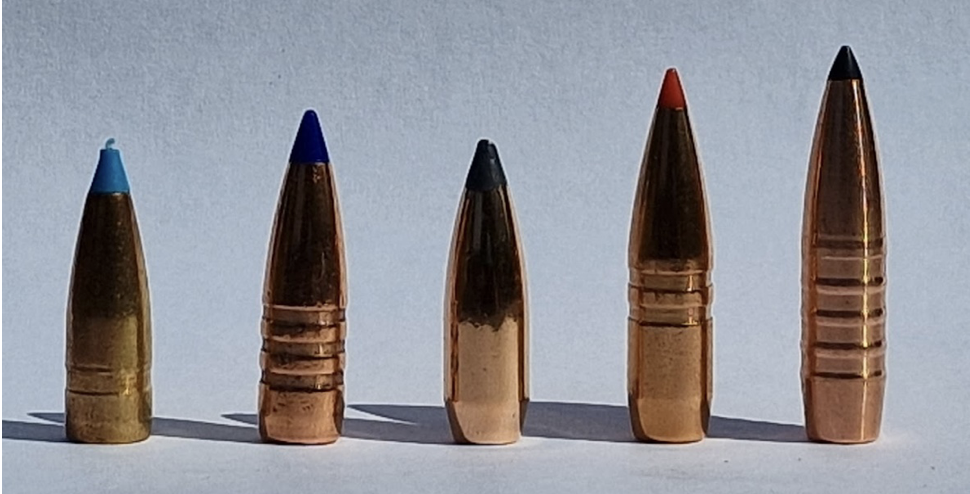
.308 bullets: Lead-free (LF) 110gn, LF 130gn, LEAD 150gn, LF 150gn, LF 167gn

As we advise our customers on rifle and ammunition choices, it is important to pass on an understanding of stability requirements and safety.  Not every rifleman will know the twist rate of his rifle.  Assumptions may be made but it would be better to offer a measurement service, together with an appropriate offer of matched ammunition.  Find a solution that offers a stability factor of at least 1.5, particularly with moderated rifles.  There are plenty of options out there but they must be able to perform.  If the customer wants lead-free and there are no easy solutions, re-barrelling or a new rifle may be the only option.

All of this information on bullet stability has been passed to the Health and Safety Executive to inform their decisions on restrictions in lead in ammunition.  There is no point in removing lead and creating additional safety risks.

Other News Posts

In Conversation with Simon West OBE, Executive Director GTA

Back to blog

Mental Health in the Gun Trade: Breaking the Stigma and Seeking Support

In the four years since I joined the GTA, it is sad to reflect that I know of four occasions when members of our gun trade family have taken their own lives.  The effect on families, friends and colleagues is devastating.  It is tragic to reflect that the thoughts of those that make such choices have not benefitted from the help that we would all wish to give – if only we had known.  It is the internalisation of hopelessness that is so sad.

In our society it is becoming so much more acceptable to be able to talk about mental health; I am less sure that it is so easy in our sector.  Possession of firearms is rightfully restricted for the purposes of public safety.   Those of us that work with firearms or enjoy shooting know that there are judgements being made on our suitability.  Protecting our ability to possess firearms and earn a wage will be a priority.  Whether an RFD, a servant or a certificate holder, we have responsibilities that we recognise.  In our daily lives, we conduct ourselves in a way that will not prejudice the privilege we enjoy.  We take those responsibilities seriously and strive to ensure that our reputation is above reproach.

But what if life is not treating us well and the pressures build up?  All sorts of factors can affect the way we feel.  Past traumas, family difficulties, and financial challenges – can all create stress.

Stress is quite natural, part of everyday life.  The difficulty comes when the stresses of life build up and prevent us from operating objectively.  If we feel that we might lose the very licence we need to work, it is easy to hide the difficulties that we are facing.

Actually, the facts show that our licensing authorities are understanding and committed to helping.  Just because we face challenges, doesn’t mean we are automatically going to lose our ability to work with guns.  There are countless examples of those who have asked for help and are managing their anxieties and depression, who continue to shoot or work in the gun trade.  The key is being open and having that conversation.

It is time we all need to look after ourselves and each other better.  I am all too aware that talking about our challenges isn’t easy.  We operate in a competitive, strong-willed environment, where there are enduring stigmas relating to talking about mental health.  Perhaps we should be more generous to ourselves and talk more openly about challenges.  Our trade has always faced headwinds – I am busier fighting these now than ever before.  Add to that challenges at the personal level and sometimes it can be difficult to see a clear way forward.  You will not be the only one under pressure and sharing those concerns can be very cathartic.

Not everybody works as part of a team but sharing our thoughts with others can help with managing difficulties.  Sometimes help comes easily from those around us.  Simply ‘A trouble shared is a trouble halved’.  For those that work alone, it’s more difficult, but there are always those willing to listen.  During lockdown, I felt privileged to take calls from members who just needed somebody to chat to.

Do continue to use the team here – it’s important for us to know what you’re having to deal with.  01684 291868.

We often hear that talking to our GPs is the right way forward – but this will be a challenge in itself.  There is a hugely useful little clip, published by Mind.org.uk about how to prepare for that move here.

Recently in Scotland, the shooting organisations, the GTA and the Police have issued a helpful guide on ‘Firearms and Mental Health – Awareness and Support’.  It recognises that problems are more common than you think and promotes positive mental health through shooting.  It talks about the role of the police in protecting public safety and the procedures they use.  But most usefully it provides information on ‘Where can I turn for help’.

You can read it at sacs.org.uk It includes some useful numbers and we hope to provide further advice across the UK soon.

The Gun and Allied Trades Benevolent Society is another port of call, assisting with financial support and connections to other organisations that can help.  More on their website: Gatbs.co.uk

We must ensure that we protect shooting as a whole and reduce risk to ourselves and others.  It is essential that members of the trade and the shooting community have a positive, open and frank relationship with their GPs and firearms licensing departments.

We know it’s difficult to talk about troubles but it’s very difficult not to answer a question.  Get into the habit of checking up on others.   We are all in this life together and need one another.  Please don’t leave it too late to look after yourselves or your mates.

Other News Posts

Gun Trade Association RFD Training Courses

Back to blog


Paul Green, Technical Advisor GTA, takes us through what you can expect when you attend one of our RFD courses.

The focus of the GTA RFD two-day course is to offer support, further information and help to non-RFD holders looking to set up a business in the trade, as well as offering current RFDs the opportunity to refresh their knowledge of best practice guides as well as their key responsibilities as dealers.

We cover the core of RFDs, Section 1 and Section 2, but there is the opportunity within the course to do several spin-offs – for example, we can migrate the course to Section 5 dealers and the different needs they face or can develop a separate course for the airguns ensuring that you, your company and employees are up to date will all new legislations, and safety protocols within the law.

If you want to find out more or sign up for one of our courses, please check out our website for the dates of our latest session, or email tech@gtaltd.co.uk for more information.


Other News Posts

Parcelforce

Back to blog

Getting our firearms from A to B

One wintery day in March I went to Coventry to meet Parcelforce Worldwide’s National Sales Manager. With safety boots and a high-vis vest in hand, we signed in with three security guards before entering the Parcelforce Hub.  Parcelforce’s hub, when it was built twenty-five years ago, was the biggest workplace in the UK. The Ⅰ shaped hub stretches for a quarter of a mile and parcels take 8 minutes to pass through all the scanners and crossovers. The maximum weight the hub can handle is 30kg and the maximum length is 2m. Scanners record the size and weight, and this is calibrated for trading standards.

The impressive figures go on, 4500 individual trays can be circulating the hub at any one time and the hub can process a mind-boggling 40,000 items an hour. 56 trailers are unloaded and 106 are loaded at any one time. Most of the Parcelforce packages from all over the UK go through this hub. To look on from the observation platform above is like observing worker ants in their nest.

The information stored in the barcode on the label is all important. It’s called ‘pre-advice’. No label means the parcel goes around the system up to five times and eventually lands with a person who has to manually type the delivery postcode into the system. As long as the parcel has a barcode and it is firmly attached to the parcel it shouldn’t get lost or be delayed. There are a number of items in the lost property department. After strenuous efforts have been made to reunite them, they go to auction.

So, to our parcels, from the firearms accounts. We have negotiated GTA members a discounted rate with no minimum amount to send. 1000 firearms packages go through the system each week. Ammunition will not be carried. The firearms must go by road, not plane, on a 24 hr am secure service. Northern Ireland, the Isle of Man and the Scottish Islands go on an Express48 service by road and boat.

The service is for sections 1 and 2 only (as defined by the Firearms Act 1968), imitation firearms, de-activated guns, antique firearms, paintball guns and inert projectiles (not prohibited by s5 of the Firearms Act 1968). Both the sender and the recipient for section 1 and 2 must be Registered Firearms Dealers.

They must be in plain cardboard packaging, not a plastic gun case, that is clearly labelled ‘strictly addressee only’ and ‘do not leave with a neighbour’.

Firearms have a special team at the hub. Experienced people and Spaniels trained to sniff out and spot anything going through the network which seems amiss.  This team works very closely with Border Force, situated just a stones throw away, and also our Firearms Team contacts in the office, my ever-helpful, first port of call.

Parcelforce cannot offer any international services for firearms traffic, including for stocks or gun parts, and ammunition or compressed gas can’t be sent through the system.

Following earlier talks with the Parcelforce Firearms Team, the GTA negotiated and agreed on a rate of £13 per parcel on any ‘subsequent parcels.’ These are for those who send more than one parcel to the same destination, booked and collected on the same day. This equates to a saving of £3.20 + fuel (which is currently 15%) + VAT per parcel. You need to let the team know in advance that you would like this discount, by emailing firearms.accounts@parcelforce.co.uk If you can organise sending your parcels to the same receiver at the same time, you will be quids in!

Listen up angling shops…

A new deal for additional accessories is now in place, and under review in four months’ time. Details are as follows but my advice is use it or lose it. The manual handling charge of £7.45 will be waived on all items between 1.1m – 1.5m. The maximum dimensions are up to 150cm or 300cm length and girth.

Using the already-in-use rates, the maximum rate would be fixed at no more than £5.84 on 24hr, and individual companies would receive bespoke rates dependent on their own circumstances/volumes. For larger senders, I am sure we can get much better bespoke rates.

Quotes via firearms.accounts@parcelforce.co.uk

Parcelforce advise you pack fishing rods in triangular packing, not tubes – a cuboid box is OK too, basically anything that does not roll around on the trays, as these would be manual due to packaging items and would attract a £2.95 + fuel + VAT fee.

Low-powered air weapons as defined by the act (air rifles, air guns and air pistols), together with lead pellets and other airgun and airsoft projectiles, can be sent but are subject to the following conditions:

  • These items must be sent on an express48 service only
  • They must be sent via the Post Office only
  • They must be presented at the counter and enhanced compensation is not available.

My thanks go to the Parcelforce team for their time in showing me the colossal mechanism which gets our firearms from A to B.

To join the GTA and get a Parcelforce account which could save the cost of your membership and more, contact office@gtaltd.co.uk

Other News Posts

Credit Card Fraud

Back to blog

Be alert to card scammers and protect your business.

The Gun Trade Association has been made aware of an increasing number of examples of credit card fraud across all retail environments, including the gun trade. The most recent was for an expensive air rifle and the retailer was not compensated. The scammer used chip and PIN. 

We spoke with Worldpay’s Luke Bryan so that he can help you be alert to card scammers and protect your business.

Why are we seeing an increase in these scams Luke?

“COVID-19 has accelerated the switch to card payments and transformed consumer behaviour, with a new report by Worldpay showing that cash payments dropped by 13% in 2020. The report forecasts that by 2024, 7% of in-store purchases will be made in cash, with a third of payments being made by mobile.

While businesses are right to embrace digital transactions to meet customer expectations and streamline the experience at the till, there are new risks in the form of card fraud. UK Finance’s Fraud the Facts 2021 report found that fraud losses on UK-issued cards totalled £574.2 million in 2020.”

So, what should the retailer watch out for?

  • “Sometimes a fraudster will make a payment over the phone or online using a compromised card and then request to collect the goods via a courier service, or friend/relative. This is because their address doesn’t match the legitimate cardholder’s.
  • Often the payment is for a large order — possibly larger than you’d normally accept — and sometimes split over several cards.
  • Be aware of last-minute changes to the delivery address and requests to send items to hotels, guest houses or PO boxes.
  • Fraudsters may also contact your business claiming to work for your payment service provider (PSP). They may claim there’s a problem with your terminals and request card transactions be processed via the phone with their ‘operatives’ – including full details.
  • They might even send an ‘engineer’ who arrives unannounced and requests previous card transaction details to perform ‘checks’ on the machines.
  • In a face-to-face environment, fraudsters may even try to bypass chip and PIN and magstripe checks by using damaged cards.”

What can the retailer do?

“To reduce the risk of fraud losses, always follow the prompts on your terminal, train staff regularly in anti-fraud measures, and follow your instincts. If something seems dubious, it probably is. That could mean:


  • Multiple cards being used for one payment
  • Orders way above your usual transaction amount
  • Customers with multiple delivery addresses
  • Requests for collection via a courier
  • Multiple declines on different cards
  • Customers Bypassing Chip and Pin

Remember, card authorisation doesn’t mean a transaction is fraud-free, merely that the card hasn’t been reported lost or stolen and that there are funds in the account. Any customer insisting on collecting items in-store should produce the card used. You should cancel the original CNP transaction and process a new chip and PIN sale.

Implement 3D Secure authentication checks on your website to reduce online fraud and liability and comply with PSD2, and partner with a PSP that runs its own fraud checks in the background for every transaction. Address Verification Service (AVS) and Card Verification Code (CVC) — also known as CVV, CSC or CVV2 — are also useful checks to make for CNP transactions.”

And if the worst happens, what next?

“If you are hit by fraud but have been unable to recover your money, report it to Action Fraud, the National Fraud & Cyber Crime Reporting Centre. This will provide you with a Crime Reference Number (CRN) which will enable the police to look into the case. That same CRN will allow you to update the report with any new information. Action Fraud also has a list of resources designed to help businesses protect their revenue and reputation and streamline the reporting process.

With fraud losses on the rise, it pays to stay alert in order to protect your business profits and reputation. But if you do get hit, reporting it will at least ensure the authorities gain a clearer picture of fraud patterns up and down the UK.”

For a FREE Payments health check, from market-leading provider, Worldpay get in touch with me at lin@gtaltd.co.uk at The Gun Trade Association or email Worldpay’s RFD representative Luke, on luke.bryan@fisglobal.com  

Other News Posts

Unveiling the World of Firearms with Nick Doherty, Criminal Barrister

Back to blog

Delving into the world of firearms law

In our captivating interview with Nick Doherty, we delve into the world of firearms law and the remarkable journey of a criminal barrister turned firearms specialist.

Nick Doherty is a criminal barrister and has practised at the criminal bar for 35 years, prosecuting and defending all types of cases. His particular interest is in firearms, whether involving criminal offences or firearms licensing matters. A large proportion of his practice now involves regulatory work, particularly in relation to firearms and explosives and health and safety work.

When did your interest in firearms begin? I went on a pistol shooting course in 1987 and got hooked. I got my FAC in 1988, my first gun was a Beretta 92. I didn’t have a shotgun certificate until about 2012.

Did you always intend to specialise in firearms law? No, originally, I was a criminal barrister, prosecuting and defending.  I got instructed to represent one of the other customers at my gun-shop, the case (Stubbings 1989) is still the definition of ‘ammunition’ in English law. I did more firearms work as the years went on, and now don’t do much else.

Your most interesting case? Going to see a client on death row in Jamaica. After we saw him he wrote to my solicitor and said “Now I’ve met Mr. Doherty I know I’m going to be all right”. Luckily the Privy Council allowed his appeal.

What are the main challenges faced by RFDs in law? The most common problem in my experience and I only get asked when things have gone wrong, is failing to comply with the various rules and regulations regarding registers and notifying servants. It is sometimes difficult to give an answer! There are as many different questions as there are dealers. One of the most common are questions regarding the classification of firearms.

How should they mitigate risk? Follow this advice!

What lessons can be learned from your experience? How should RFDs stay on the straight and narrow? Complying with the rules is not necessarily a legal requirement. For example, Section 8 of the 1968 Act has not been changed. Any servant of the RFD is entitled to the same legal right to possess firearms etc. as the principle of the firm. However, most licensing departments will now try and argue this is not the case unless you have notified them as a servant. Whether someone is a servant is a question of fact, not of whether they have been notified to the police. Some RFDs might like to argue the toss, but it is pointless, just do what the police ask you to do. You might be correct legally, but why bother with the argument and risk your business?

So, there’s a need for training? It is important that your registers are not only completed accurately and in a timely fashion, but it helps if they are easy to understand. I am aware of RFDs who have been taken off the Register for not correctly recording items disposed of as scrap. There is a need for training regarding record keeping, but there is also a need to understand the police have something you want, and it is best to cooperate and do what they require. Being on top of your registers and the stock when you have an audit is very helpful.

Are you finding that you are dealing with more firearms licensing appeals recently? Yes, but this is because of the police reaction following the Plymouth shooting and the introduction of the Statutory Guidance in December 2021.

Can you tell me a little about your work for the CIC? I am one of 3 international lawyers for them. One English, one French and one Austrian. As I am the only one who understands the common law, I get to do most of the work. The International Council for Game and Wildlife Conservation, to give them their English title, support the sustainable use of wildlife and supports local communities across the world. They are recognised as an International Non-Governmental Organisation by the UN.

I know that you’re a keen shooter with a varied collection of nice guns, but I’m interested that you’re a biker too. Yes, I ride a Triumph Trophy back and forth from the airport, the parking is free. The bike gear will go in the panniers, and I strap my wheely case onto the back of the seat with bungies.

I have the purple Firearms Law Handbook, which you co-wrote with GTA partner Laura Saunsbury, on my desk and suggest that every RFD purchases a copy for themselves via Amazon. Can you tell me about it? Laura Saunsbury and I were asked to update a book entitled Gun Law in 2011. The previous book was written by a Lincolnshire solicitor who had passed away after 6 editions. It was a book aimed at the shooter and the police officer, as much as the lawyer. We changed the title but have tried to continue the concept. It is hard work writing a textbook, you always get something wrong, and it is very badly paid. The second edition came out in 2019 and we will have to bring out a new edition in the next year or two to deal with the Statutory Guidance and increased attempts by licensing departments to have their evidence declared subject to PII and therefore not disclosed to the appellant.

Laura is a trade member of the GTA. We represent many dealers, large and small who are under increasing scrutiny from the police. For dealers’ advice at an early stage can be very important. Explaining what you are doing and how it conforms to the legislation is important.


Our conversation with Nick has provided a captivating glimpse into the intricate world of firearms law and the challenges faced by practitioners. With his wealth of experience and expertise, his insights have shed light on the evolving landscape of firearms licensing and the need for ongoing training to ensure adherence to regulations.

Thank you to Nick for his time and for his valuable contributions to our understanding of firearms law.

Other News Posts

Gun Trade Association AGM June 2023

Back to blog

Navigating International Trade Challenges: A Conversation on Gun Trade and British Representation

Simon West OBE, Executive Director of the GTA Ltd, is excited about getting a team together to discuss international trade, the challenges we face, the issue of limited British representation in the gun trade, and finding ways to ensure proper and safe movement of goods.

Adrian Bond, Department of International Trade, shares his insights on exporting firearms, global security, and how his team, along with connected departments, actively support responsible exports and trading.

Marleen Meyer, Project Executive OTSA talks to us about this year’s IWA Outdoor Classics event and the figures from both the attendees and exhibitors of the event.  She also gives us a sneak peek into the 50th anniversary IWA Outdoor Classics 2024 in Nuremberg. One event you might want to attend.

And Gary Costello, Managing Director PBS International Freight Ltd; a company that specialises in handling the transportation of firearms and other restricted items that most other freight companies shy away from, dives into the concept of consolidating shipments and proposes ideas to simplify the shipping process for the British gun trade, ultimately benefiting traders.

Simon then opens the floor to the attendees for a fascinating Q&A.

Other News Posts

In Conversation with Simon West OBE, Executive Director GTA

Back to blog

Firearms Licensing Statistics Reveal Challenges and Opportunities for the Trade

The Home Office has just released their statistics on firearms licensing for England and Wales and Police Scotland has done the same North of the border.  As a Trade we need to give these some attention.  I would certainly recommend those with an eye for detail to visit the published pages and the data tables to do your own analysis.  In England and Wales, for example, there are data down to police force levels.

As you’ve seen in the GTN headlines, certificate holders are dropping – about 5% down in England and Wales but less than 2% down in Scotland.  But interestingly, the total number of firearms held on certificate across both areas has increased slightly.  The number of registered firearms dealers remains steady.

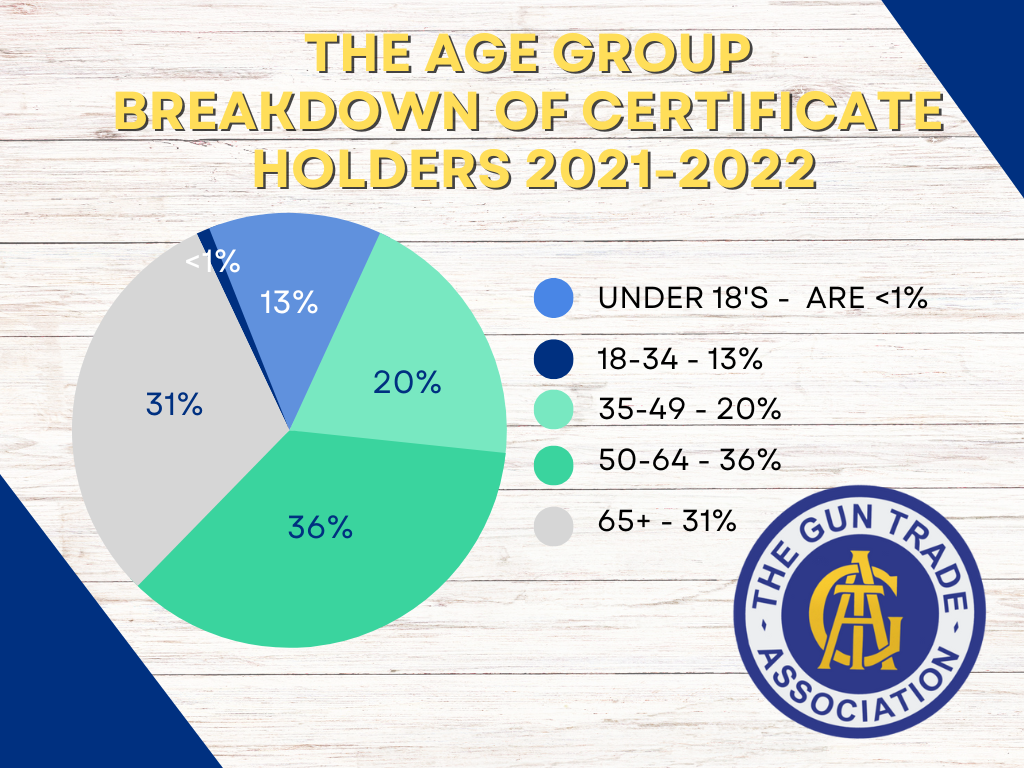
You have heard me bang on about the enduring need to bring young blood into our shooting sports.   If you ever needed convincing that we all need to do more, then the latest Home Office statistics on firearms licensing provide some startling realities.   The numbers show that almost 70% of certificate holders are over 50.  Of course, not all shooters come into the sport in their early years but there is a significant decline in the applicants between 18-49.  Between 2017 and now we are seeing half the number of certificate holders in the 14-17 age group and about a 14% reduction in the 18-34 age group.

This should be a wake-up call for us all. 

We made huge gains during the lockdown with the sale of airguns – many of which will have introduced youngsters to shooting.  Now we must find ways to bring on that group with their shooting ambitions.  Whether the next stage is small bore rifle, clays or pigeon shooting, think about what you can do to develop your potential customer base.  With so many of you providing a fantastic service looking after guns for those awaiting renewals etc., please also provide encouragement for shooters to get their guns out when they can and engage with their sport.  All too often, after a period away from the range and when funds are tight, it’s easy for folk to wander.

Rekindle their interest, advertise events, generate new networks, buy a new gun….!

Some of these drops can be laid at the efficiency of police departments, some at the greater number of people leaving the sport, than joining.  What is clear right now is that delays in licensing are preventing those who desire to pick up shooting as a sport, from getting on with it and spending their savings with us.  Just today I challenged the national police licensing representative to push for a re-prioritisation of grants.  I made the point that for small companies in particular, grant delays have a direct impact on cash flow and the survivability of businesses.  He undertook to raise the issue at the FELWG meeting next week and report back.

Finally, on statistics, there is a table at the end with details of lost and stolen firearms.

The data has only been published in the last two years but the number has increased.  Over 400 items were reported, with 335 shotguns lost or stolen.  These figures do no credit to the shooting community and only lead to more demands for revocations and a tightening of the law.  Of the 335 shotguns, 118 were ‘lost’.  I have no idea how you can lose a shotgun, but I am absolutely sure they will end up in the wrong hands.  Likewise, obviously, the stolen guns.  We cannot carry on like this.  Restrictions will be placed upon us.  Whether as a certificate holder yourself or as a dealer, we must maximise the security of firearms.

In the coming months, you will see reminders from the police about security, especially as the game season approaches.  Please help us all by reminding your customers and fellow members of your clubs and shoots, of the importance of protecting guns and ammo.  Coming from an RFD, they should be alert to your message.

Thankfully this industry is not all about doom and gloom.  I very much enjoyed visiting the Scottish Game Fair with its traditional, intimate offering – for 32,000 visitors!  It was good to see many of you there.  Next year we would all like to see more gun trade stands there, especially if you have something special to offer.  By increasing the offer, the show will attract more shooters with a will to buy kits.  It’s called a ‘game fair’ for a reason!

Then Ragley Hall next – 29-31 July.  I understand Gunmakers’ Row is looking good with notable attendance from the Trade.  We will be running the Gunmakers’ Theatre again with a variety of presentations throughout the weekend.  Some well-known names – Bill Blacker, Simon Reinhold, Diggory Hadoke, Mark Osborne, Dave Mills, Gavin Gardiner amongst others– all talking on their specialist topics and ready to answer the inevitable questions about lead.

If you’ve finished putting up your stands on Thursday evening and need some liquid refreshments, please drop by for some Trade Drinks.  Together with the GTN team, Lin, Kerry and I always appreciate a chance for a face-to-face chat and to talk more about what we are doing behind the scenes to deal with the big issues.

See you there.

This graph shows the age group breakdown of certificate holders 2021-2022.

Other News Posts